Wedding Reception Order of Events
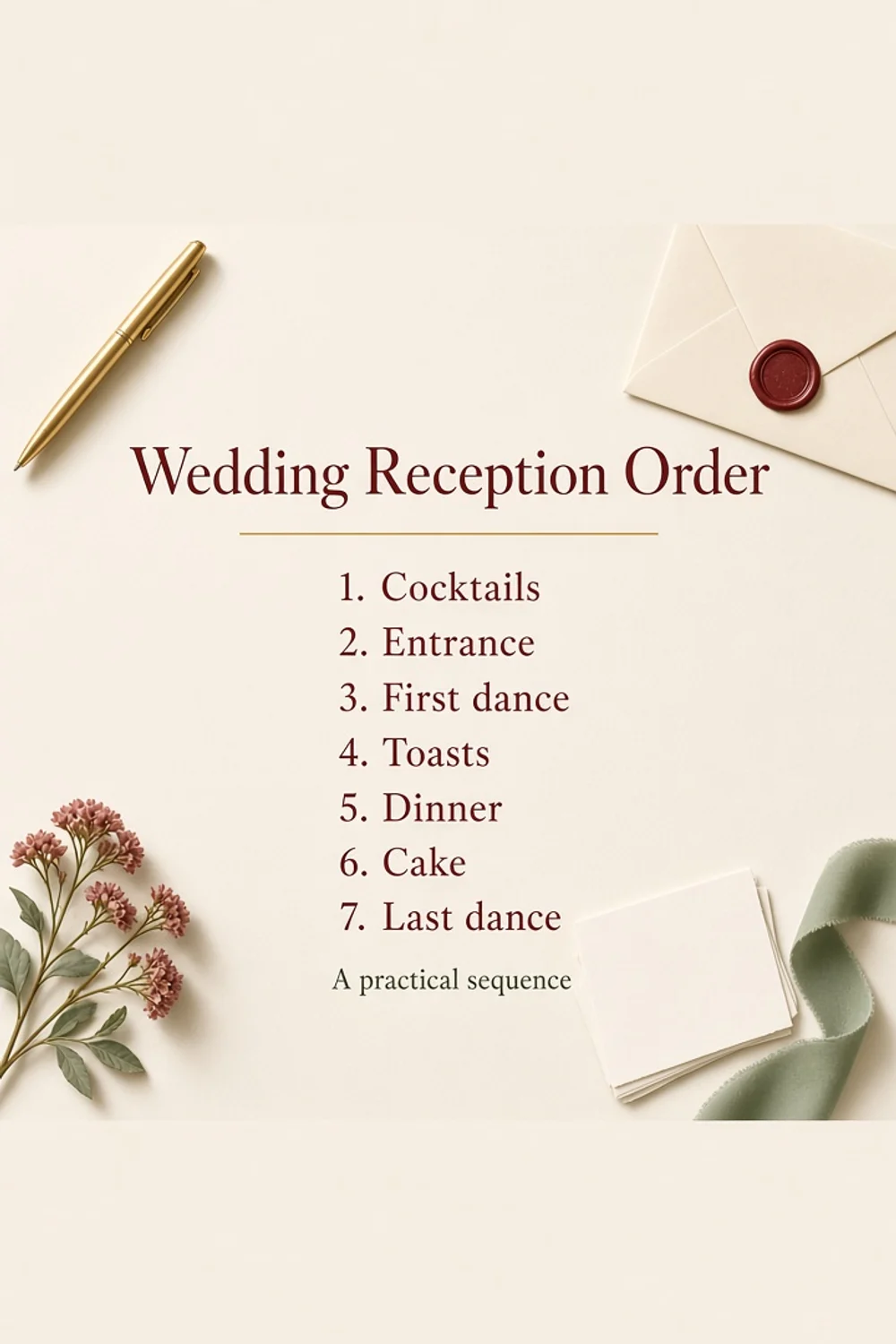
A wedding reception order of events is the sequence after the ceremony: cocktails, the couple's entrance, a first dance, toasts, dinner, cake, open dancing, and a last song. In The Knot 2026 Real Weddings Study of 10,474 US couples who married in 2025, 87 percent of couples kicked off the reception with a first dance.
That order is the running list your DJ, caterer, and photographer work from. Publish the cocktail time and the dinner time for guests. Leave the song list with the DJ.
The Sequence to Hand Your Vendors
Write one list and send the same list to the venue, the caterer, and the DJ. The room stays calm when those three people are looking at one page.
- Cocktail hour, while you finish photos.
- Guests find their seats.
- Your entrance, with the wedding party only if they want the walk.
- First dance.
- Welcome and toasts.
- Dinner.
- Cake.
- Open dancing.
- Last dance or grand exit.
Move the first dance, the toasts, or the cake if the room works better that way. Keep dinner's start time fixed. A caterer needs a clock time, because an open-ended speech block pushes the meal.
Cocktail Hour
Cocktail hour is the gap between the ceremony and the seated party. Guests have a drink and a small bite while you take the portraits that need an empty aisle. When the ceremony and reception share a building, this gap can be short. When guests drive between the two sites, add that travel before anyone is asked to sit.
One in two couples in the 2026 study had a first look before the ceremony. A first look is a few private minutes with your partner and the photographer before guests sit for the vows. It clears portraits off the cocktail-hour list, which keeps dinner on time.
The Entrance and the First Dance
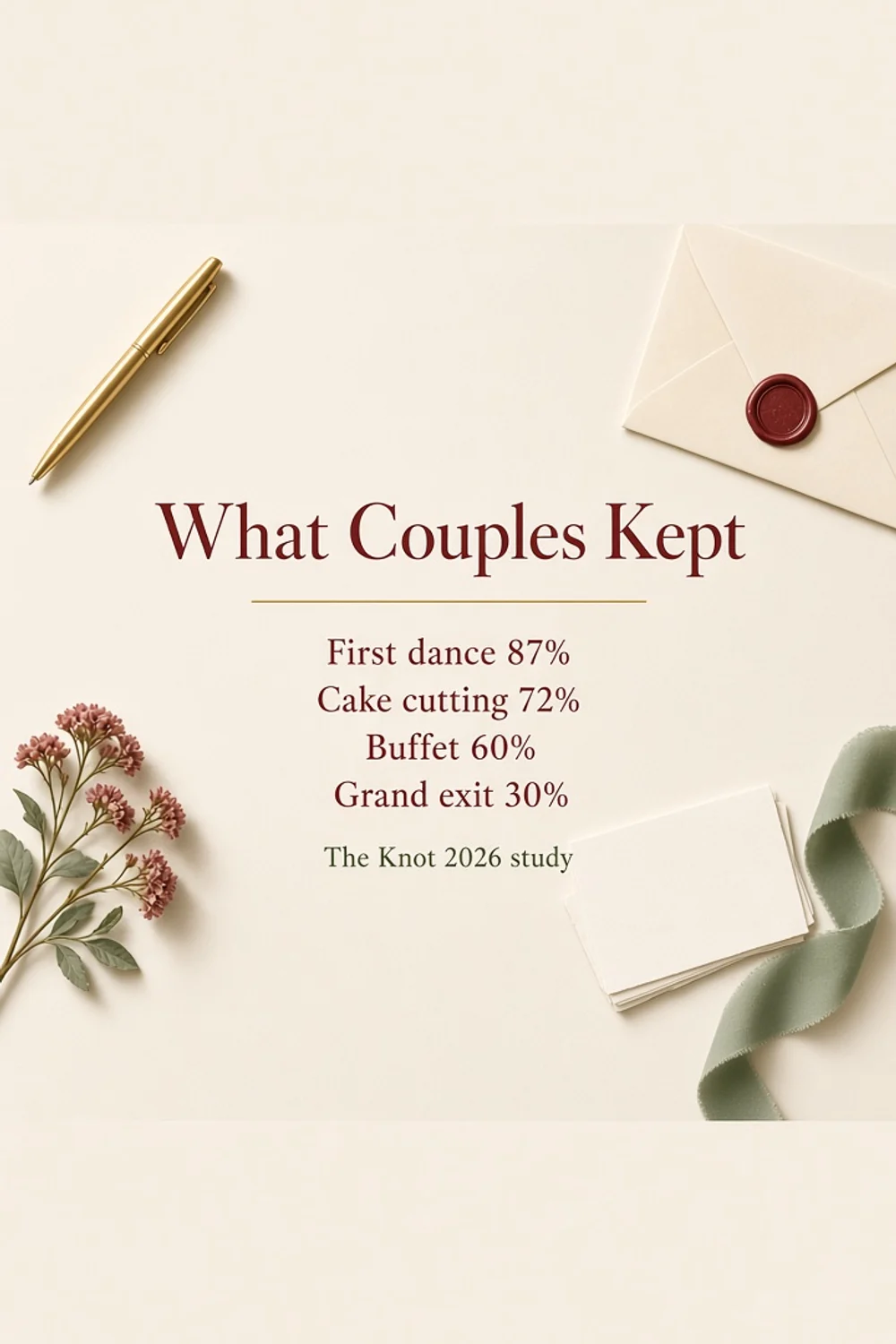
In the 2026 study, 87 percent of couples kicked off the reception with a first dance. Use the entrance as that moment, or play the song as soon as you are announced. A couple-only entrance is a complete start.
Parent dances can be their own songs after yours. They can also happen inside your first song: you start, your parents join, and the floor opens. Tell them which plan you are using before the reception, so nobody waits for an announcement that is not on the list.
Toasts
The Emily Post Institute says the first reception toast is traditionally the best man's, once every guest has champagne or a nonalcoholic drink. At a seated dinner, give it when everyone is sitting. At a cocktail reception, give it after you arrive. One toast is a complete program. Parents and a maid or matron of honor can follow. The Institute keeps a toast to a minute or two, and three minutes at the longest.
Words for each role are in wedding speech examples. Agree on the order and the length before the rehearsal, and give that order to the person introducing the speakers.
Dinner
In the 2026 study, 60 percent of receptions used a buffet or self-serve stations, and 30 percent used a plated sit-down meal. A buffet lets guests move. A plated meal needs a choice collected before the wedding. Ask for that choice on the RSVP, with the lines in wedding website meal choice wording.
Seats come before the welcome. Build the chart after the replies are real, using the seating chart guide. A guest who is still looking for a chair will miss the first toast.
Sixty percent of couples in the study called their wedding semi-formal, and 19 percent called it formal or black tie. Put the words guests should wear next to the reception time. Lines for each level are in wedding website dress code wording.
Cake, a Dessert Table, and the Bouquet
Cake cutting was part of the reception for 72 percent of couples in the 2026 study. Do it while guests are still in the room, so the photographer has light and a crowd. Then open the dance floor if it is not already open.
Fifty-three percent of couples added a dessert bar. Among those couples, 45 percent served cookies, 39 percent served cupcakes, 18 percent served cheesecake, 11 percent served an ice cream bar, and 10 percent served donuts. A dessert bar can sit beside the cake. It can also stand in for the cake if you would rather skip the cutting.
A bouquet toss happened at 24 percent of the weddings in the study. Keep it when your crowd wants it. Leave it off the list when you would rather go straight to dancing.
The Last Song and the Exit
Thirty percent of couples in the 2026 study staged a grand exit with sparklers, fireworks, or a carriage. A last dance closes the night when you skip the exit. Tell the DJ which one is the end, and tell guests where to stand if there are sparklers.
An after-party is a separate event. In the same study, 27 percent of couples had one, and 71 percent of weddings spanned two or three days. If the night continues, name the handoff in the reception order: last dance, then the after-party address. How to write that handoff is in wedding website schedule wording.
A Receiving Line
The Emily Post Institute treats a receiving line as optional. You still greet every guest. A line is the reliable way to do that at a wedding of more than 75 people. At a smaller wedding, visit each table during the meal.
Hold the line as guests leave the ceremony, or at the reception after formal photos. The host stands first. Traditionally that is the bride's mother, then her father, then the groom's parents, then the couple, then the maid or matron of honor and one or two bridesmaids. Groomsmen can circulate. If one father stands in the line, the other should too.
When to Lock the Order
Set this sequence when you book the DJ and confirm the meal service. The wedding planning timeline puts vendor confirmation in the last two weeks. Send the locked order in that same pass, with the clock time each block should start.
Weddnesday is a simple place for that order to sit next to the RSVP, so a guest can see when dinner starts without a separate text.
Reception Order Checklist
- Write one order and send it to the venue, caterer, and DJ.
- Put cocktail time and dinner time on the wedding website.
- Decide whether the first dance opens the reception. In the 2026 study, 87 percent of couples started that way.
- Name who toasts, and keep each toast to a minute or two.
- Choose buffet or plated service. Collect a meal choice for a plated dinner.
- Schedule the cake while guests are still in the room.
- Pick a last dance or a grand exit, and say which one ends the night.
- Plan how you will greet every guest: a receiving line, or a visit to each table.
FAQ
What is the order of events at a wedding reception?
Cocktails, the couple's entrance, a first dance, toasts, dinner, cake, open dancing, and a last song or grand exit. In The Knot 2026 Real Weddings Study of 10,474 US couples who married in 2025, 87 percent kicked off the reception with a first dance.
What is a wedding reception order of events?
It is the running order of the party after the ceremony. Your DJ, caterer, and photographer use the same list, and guests need the cocktail time and the dinner time from it.
When should the first dance happen?
Most couples in the 2026 study used it to open the reception: 87 percent kicked off with a first dance. You can also place it after dinner if you would rather eat first.
Who gives the first toast at a wedding reception?
The Emily Post Institute says the first reception toast is traditionally the best man's, after every guest has a drink. One toast is enough. Parents and a maid or matron of honor can follow.
When should wedding toasts happen?
At a seated dinner, give the first toast once everyone is sitting. At a cocktail reception, give it after the couple arrives. The Emily Post Institute keeps a toast to a minute or two, and three minutes at the longest.
When do you cut the cake at a wedding reception?
Cut it while guests are still in the room, usually as dinner winds down. Cake cutting was part of the reception for 72 percent of couples in the 2026 study.
Do you have to do a bouquet toss?
No. A bouquet toss happened at 24 percent of weddings in the 2026 study. Keep it when your crowd wants it, and leave it off the order when you would rather go straight to dancing.
What is a wedding grand exit?
A grand exit is a staged goodbye at the end of the reception, such as sparklers, fireworks, or a carriage. Thirty percent of couples in the 2026 study had one. A last dance can close the night instead.
Do you need a receiving line?
No. The Emily Post Institute says a receiving line is optional, and that you still greet every guest. A line is the reliable way at a wedding of more than 75 people. At a smaller wedding, visit each table during the meal.
Is a buffet or a plated dinner more common at a wedding reception?
A buffet or self-serve stations were more common in the 2026 study, at 60 percent of receptions. A plated sit-down meal was used at 30 percent.
What is a wedding first look?
A first look is a few private minutes with your partner and the photographer before the ceremony. One in two couples in the 2026 study had one. It is separate from the reception order, and it shortens the photo list during cocktail hour.
How do guests know the reception order?
Put cocktail time, dinner time, and any after-party on the wedding website. In the 2026 study, 27 percent of couples had an after-party, and 71 percent of weddings spanned two or three days, so guests need to see where the reception ends.
Save These Guides for Later
Wedding Website Meal Choice Wording
Wedding Guest Seating Chart Guide
Wedding Website Dress Code Wording
Wedding Website Schedule Wording
Stay Connected
Follow Weddnesday for practical wedding planning guides, guest communication, and wedding website ideas.
Save This on Pinterest