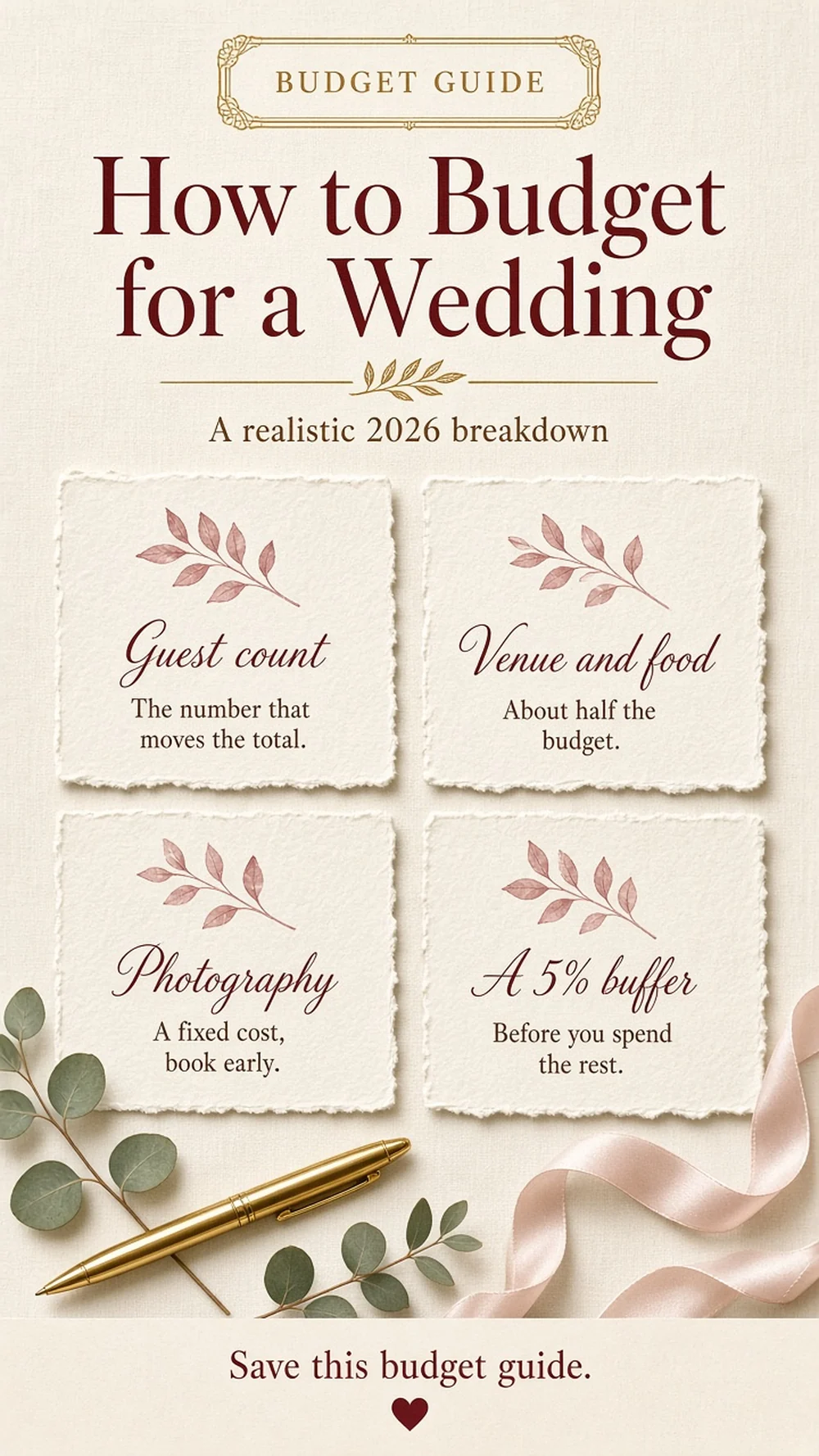
How to Budget for a Wedding: A Realistic 2026 Breakdown
A wedding budget starts with the money you can spend. The national average is useful after that number exists. It tells you what other couples paid. It does not tell you what your celebration should cost.
The figures in this guide come from The Knot 2026 Real Weddings Study of 10,474 US couples who married in 2025. Category shares come from The Knot’s published budget breakdown of that same study. Use them as a map, then price the city, guest count, and vendors you actually have.
Start with the Cash
Write one number before you collect venue photos. That number is money you and your partner can put toward the wedding, plus contributions a family member has already promised in plain language. A hope is not a line on the sheet. A promised amount is.
Put the number at the top of a spreadsheet and leave it there. Every quote after that is a request to spend part of it. If a quote does not fit, the quote changes, the guest list changes, or a lower-priority line gives up room. The total stays.
The only required wedding expense is the legal cost of marrying. Everything else is a choice about the celebration: who is in the room, where the room is, and which parts you want to remember on purpose.
What Couples Actually Spent in 2026
The average US wedding in the study cost $34,200. The average guest count was 117, and the average cost per guest was $292. Those three numbers describe a large national mix. They hide the spread underneath.
- Budgets up to $15,000: couples in this range spent $8,900 on average.
- Budgets from $15,001 to $40,000: couples in this range spent $26,400 on average.
- Budgets over $40,000: couples in this range spent $70,300 on average.
If $34,200 is more than you can spend, you are in a large group of real weddings. If you are planning well above it, the average will make your quotes look inflated when they are ordinary for your city. Pick the band you are actually in, then build the sheet inside it.
Guest Count Moves the Total
Guest count is the decision with the widest effect, because food, drinks, rentals, and favors follow the headcount, and several other costs do not.
- 1–50 guests: $17,100 on average.
- 51–100 guests: $27,200 on average.
- More than 100 guests: $43,300 on average.
The $292 per-guest figure is a national average across all of those weddings. It is a sketch, not a quote. An 80-guest sketch of 80 × $292 is about $23,400, which lands near the middle guest-count band and well under the headline average. Use that sketch to see the scale. Then replace it with local quotes.
Price the high end of the range you might invite. A sheet built for 90 people breaks when the real list is 120. A sheet built for 120 can release money after the RSVPs come in.
Some costs stay put when the list shrinks. Photography, a DJ or band, the officiant, and most attire cost about the same for 70 guests as for 110. Catering, bar, rentals, stationery, and favors move with the list. Cutting 20 guests saves the moving costs. It does not refund the photographer.
When you are ready to say who is included, put that in writing for guests. How to explain who’s invited keeps plus-ones from becoming a budget surprise after the invitations are out.
Place Moves It More Than the Month
A hometown wedding in the study averaged $32,600. A domestic destination wedding averaged $41,700. An international destination wedding averaged $43,700. Smaller guest lists at destination weddings do not automatically make the day cheaper, because travel, lodging, and shipping sit on top of the celebration.
State averages in the same study run from about $17,000 in Wyoming to about $57,000 in New Jersey. New York State averages about $49,000. New York City averages about $88,000 for the ceremony and reception. A city can sit far from its state. Price the place you will actually use.
Season moves the number less than people expect.
- January–March: $33,200
- April–June: $34,300
- July–September: $35,400
- October–December: $33,200
The gap between peak summer and the quieter seasons is about $2,200. That is real money. It is smaller than the gap between a 50-guest wedding and a 100-guest wedding. Choose a date you want, then check whether that particular venue discounts weekdays or off-peak months. A national season average cannot see a Saturday in June at one popular room.
If guests are traveling, the budget conversation and the website conversation meet. Lodging, airports, and a multi-day schedule belong in the destination wedding website must-haves, so people can plan trips without a dozen separate messages from you.
Who Is Paying Changes the Number
In the study, the average wedding was $39,600 when the couple paid a minority of the bill, $29,700 when they paid the majority, and $25,500 when they paid all of it. Couples spending their own money tend to choose a shorter vendor list and a clearer set of priorities.
Have the money conversation with every person who is contributing before you tour venues. Ask what the gift is for, whether it is flexible, and whether it comes with a preference you are willing to honor. Write the answer down. A contribution that arrives later can fill a category. It should not be the plan that keeps the total from working.
Where a Typical Budget Goes
The Knot’s breakdown of the same study splits a typical wedding like this. The shares round slightly past 100 percent.
- Venue and rentals: 29 percent
- Catering, cake, and drinks: 24 percent
- Photography and videography: 10 percent
- Flowers and decor: 9 percent
- Music: 6 percent
- Attire and beauty: 6 percent
- Wedding rings: 5 percent
- Wedding planner: 5 percent
- Guest entertainment: 3 percent
- Transportation: 2 percent
- Stationery: 1 percent
- Officiant: 1 percent
Venue, food, and drinks together are about half. That is the ceiling to protect. A band, a floral installation, or a dress can be the part you care about most. They still have to live beside a room and a meal that fit the guest count.
You do not have to hire every line. Couples in the study hired 13 vendors on average. Thirteen is a description of what people did, not a requirement. A park ceremony, a restaurant lunch, and one photographer can be a complete wedding.
What the Shares Look Like on $30,000
$30,000 sits near the middle of the $15,001–$40,000 band, whose weddings averaged $26,400. Applied to $30,000, the shares look like this:
- Venue and rentals: $8,700
- Catering, cake, and drinks: $7,200
- Photography and videography: $3,000
- Flowers and decor: $2,700
- Music: $1,800
- Attire and beauty: $1,800
- Wedding rings: $1,500
- Wedding planner: $1,500
- Guest entertainment: $900
- Transportation: $600
- Stationery: $300
- Officiant: $300
Those lines add to about $30,300 because the published percentages round slightly past 100. Treat them as ceilings, not as bills you must create. If you are skipping videography, guest entertainment, or a planner, those ceilings return to the total. They do not need to be spent.
The Knot also suggests keeping about 5 percent as a just-in-case fund. On $30,000 that is $1,500. Park it in its own row before you sign contracts. If the ceilings plus the buffer no longer fit, take the difference from flowers, transportation, and guest entertainment before you touch food or photography.
The same math works on any total. Multiply your number by the share. A $20,000 wedding puts about $5,800 on venue and rentals and about $4,800 on food, cake, and drinks. A $45,000 wedding puts about $13,050 on venue and rentals and about $10,800 on food, cake, and drinks. The shape stays. The dollars follow your number.
Two Kinds of Cost
Fixed costs stay roughly the same if twenty people drop off the list. Per-guest costs do not.
- Mostly fixed: venue rental when it is a flat fee, photographer, videographer, DJ or band, officiant, attire, rings, invitation design, planner.
- Mostly per guest: food, alcohol, rentals charged by the piece, favors, paper invitations, and sometimes the venue minimum.
Among couples who bought these items, average prices in the study included a reception venue at $12,900, a photographer at $3,000, a videographer at $2,300, flowers at $2,800, a DJ at $1,800, a reception band at $4,500, a wedding dress at $2,100, a planner at $2,100, catering at $80 per person, alcohol at $2,800, a cake at $540, stationery at $510, and an officiant at $260.
Those prices are averages among people who hired that vendor. They do not add up to $34,200, because almost nobody hires every vendor, and a couple who hires a band often skips a DJ. Use the percentages to shape your total. Use these prices to tell whether a quote is ordinary, low, or far above what couples paid for that one thing.
Ask for the loaded total before you compare. A per-plate number that excludes tax, service charge, and gratuity is not the number that leaves your account. The same is true of a photography package that looks complete until a second shooter, overtime, or the album sits outside it.
Costs That Sit Beside the Average
Three common costs are usually tracked outside the $34,200 celebration average. Decide on purpose whether they live on your sheet.
- Rehearsal dinner: $2,800 on average. If you are hosting one, give it a row. If a family member is hosting it, leave it off your spendable total and confirm what they are covering.
- Engagement ring: $4,600 on average. Wedding bands are already inside the celebration breakdown, at about 5 percent. The engagement ring is a separate purchase for many couples, often made before planning starts.
- Honeymoon: $5,500 on average. Keep it visible so the wedding does not quietly spend the trip. A separate row is enough.
Wedding rings and the engagement ring are easy to merge by accident. If both are still unpaid, list them on two lines so the band budget does not disappear into a ring that was never part of the 5 percent.
Read the Quote Before You Celebrate the Per-Plate Price
Venue contracts are where careful budgets get rewritten. Ask these questions before you compare two places as if they were the same product.
- Is catering required in house, or can you bring a caterer?
- What is the food and beverage minimum, and what counts toward it?
- Which tables, chairs, linens, and table settings are included?
- What do tax, service charge, and gratuity add, as one dollar figure on your guest count?
- Is there a cake-cutting fee, a corkage fee, or a vendor meal charge?
- What is the overtime rate if the party runs long?
- What guest-count minimum is written into the contract?
- What happens to the price if the final count comes in lower?
A room with a higher rental and true catering choice can cost less than a “free” room with a high minimum and a required bar package. Compare the loaded totals at the same guest count. That is the only fair reading.
A Wedding Cost Spreadsheet You Can Finish in One Sitting
You need one sheet, not a new app. These columns are enough:
- Category: the lines above, plus buffer, and any extra rows you are truly hosting.
- Ceiling: your share of the total, or a blank if you are skipping that category.
- Quote: the loaded price, with tax and service included.
- Deposit and date: what is due to hold the date.
- Balance and due date: what remains, and when.
- Paid: what has actually left the account.
Build it in this order.
- Write the total you can spend.
- Add only contributions that are already promised.
- Move 5 percent into a buffer row.
- Set a guest-count range and price the high end.
- Give venue, food, and drinks a combined ceiling near half.
- Assign ceilings to photography, music, attire, and the other lines you actually want.
- Leave flowers, printing, favors, and extras until the large contracts are signed.
- After RSVPs, lower the per-guest lines and put the difference back in the buffer or into one priority you postponed.
Share the sheet with your partner and with anyone whose money is on it. One copy prevents the quiet double-booking where two people each think the other is paying the photographer.
What to Book First
Book the vendors who can take your date away, and whose price will not shrink if the guest list does.
- Venue. It holds the date and usually sets the food rules, the rental list, and the guest-count minimum.
- Photographer. Strong dates go early, and the fee stays put if you later invite fewer people. In the study, photography and videography together are about 10 percent. If you want both, decide that before the floral budget expands to fill the gap.
- Officiant, if a specific person matters to you. The average fee is small. The calendar is not.
- Music and attire come next. A band at $4,500 on average and a DJ at $1,800 on average are different products. Pick the one you want while there is still room, so it does not get funded by shrinking dinner.
- Flowers, paper, and favors can wait. They are easier to scale after the guest count is real.
A planner is a tool, not a personality. Couples who hired one spent $2,100 on average. Full planning costs more than day-of coordination. Hire the level that matches how much of the vendor search you want to do yourselves, and put that fee in the sheet before you add decor.
Where Cutting Works
Cut in the order that changes the total, and protect the parts you would be sorry to lose.
- Guest count. Moving from the over-100 band toward the 51–100 band is the difference between a $43,300 average and a $27,200 average. You will not capture that entire gap, because fixed costs remain, and your city may sit above or below the national number. You will capture the food, bar, and rental difference on every name you remove.
- The room’s rules. A lower rental with an expensive required package can lose to a simpler place. Compare loaded totals.
- Music format. A DJ and a band create different days. If dancing matters and the band quote consumes the buffer, a skilled DJ keeps the party and returns thousands to food or photography.
- Video, installations, and favors. These are memorable when you care about them. They are also the lines that can go to zero without canceling the wedding.
- The month. An off-peak date is worth asking about. Expect a smaller saving than a shorter guest list, unless a specific venue offers a real weekday or winter rate.
Leave the buffer alone until something actually goes over. Once you spend it on upgrades, you no longer have a buffer. You have a higher budget.
What Guests Should See
The spreadsheet stays private. Guests need the facts that keep them from spending the wrong money or asking you to solve logistics one text at a time.
- Who is invited, including plus-ones and children, so the headcount you budgeted is the headcount that arrives.
- Where to stay, with a room block and a date to book. Unused courtesy blocks are a planning problem. Surprise hotel nights at the last minute are a guest problem you will hear about. Wording for that page lives in wedding website accommodation wording.
- Where gifts can go, if you want them. A clear registry page reduces duplicate purchases and the guesswork of people trying to spend “the right amount.” See wedding website registry wording.
- The schedule, so out-of-town guests can book flights that match the events they are actually invited to.
None of those pages need your dollar figures. They need decisions you have already made. A useful starting list is the wedding website checklist. If you are deciding when each decision has to be public, the wedding website timeline pairs well with the order you book vendors.
Weddnesday is the guest-facing side of this work: a wedding website for the schedule, travel, RSVPs, and the updates that change after the paper is printed. The budget can stay in your spreadsheet. The details guests use should be easy to find and easy to change.
Before You Send a Deposit
- The total at the top of the sheet is money you have or have been promised.
- Five percent is sitting in a buffer row.
- The guest-count range is written down, and the quotes use the high end.
- Venue, food, and drinks fit in about half, after tax and service.
- Photography is in the sheet if you want it, before decor takes that room.
- Rehearsal dinner, the engagement ring, and the honeymoon are either separate rows or clearly someone else’s cost.
- You know which lines are fixed and which lines will drop if RSVPs come in low.
- The people contributing can see the same sheet.
FAQ
How do you budget for a wedding?
Write the total you can spend, add only promised contributions, set aside about 5 percent as a buffer, choose a guest-count range, and give venue, food, and drinks a ceiling near half of the total. Then assign the rest to the vendors you actually want.
What is the average wedding cost in 2026?
The Knot 2026 Real Weddings Study puts the average US wedding at $34,200, based on 10,474 couples who married in 2025. Couples with budgets up to $15,000 spent $8,900 on average. Couples between $15,001 and $40,000 spent $26,400. Couples over $40,000 spent $70,300.
How much should you budget per wedding guest?
The national average is $292 per guest. Weddings with 1–50 guests averaged $17,100, weddings with 51–100 guests averaged $27,200, and weddings with more than 100 guests averaged $43,300. Use your own guest count and local quotes for the real number.
What percentage of a wedding budget goes to the venue and food?
In The Knot’s breakdown, venue and rentals are 29 percent and catering, cake, and drinks are 24 percent. Together they are about half of a typical wedding.
What costs sit outside the average wedding cost?
The rehearsal dinner averaged $2,800, the engagement ring averaged $4,600, and the honeymoon averaged $5,500. Wedding bands are usually inside the celebration budget. The engagement ring, rehearsal, and honeymoon are often tracked separately.
How much should you keep as a wedding budget buffer?
About 5 percent of the total. On a $30,000 wedding that is $1,500. Leave it unassigned until a real overrun appears.
Does an off-season wedding cost less?
In the national study, July–September weddings averaged $35,400 and January–March and October–December weddings averaged $33,200. The difference is about $2,200. Guest count and city usually move the total more than the season.
What should you book first?
Book the venue first, then the photographer, then an officiant if a specific person matters. Those choices hold the date. Flowers, favors, and extra paper can wait until the guest count is clearer.
Should guests see your wedding budget?
No. Keep the spreadsheet private. Publish the guest-facing decisions: who is invited, where to stay, the registry if you have one, and the schedule.
How many vendors do couples hire?
Couples in the study hired 13 vendors on average. You can host a complete wedding with fewer. Skip any line you do not want, and return that money to the total.
Save These Guides for Later
Who Is Invited: Wedding Website Wording
Wedding Website Accommodation Wording
Wedding Website Registry Wording
Destination Wedding Website Must-Haves
Stay Connected
Follow Weddnesday for practical wedding planning guides, guest communication, and wedding website ideas.
Save This on Pinterest