How to Address Wedding Invitations: Copy-Paste Envelope Examples for Every Guest
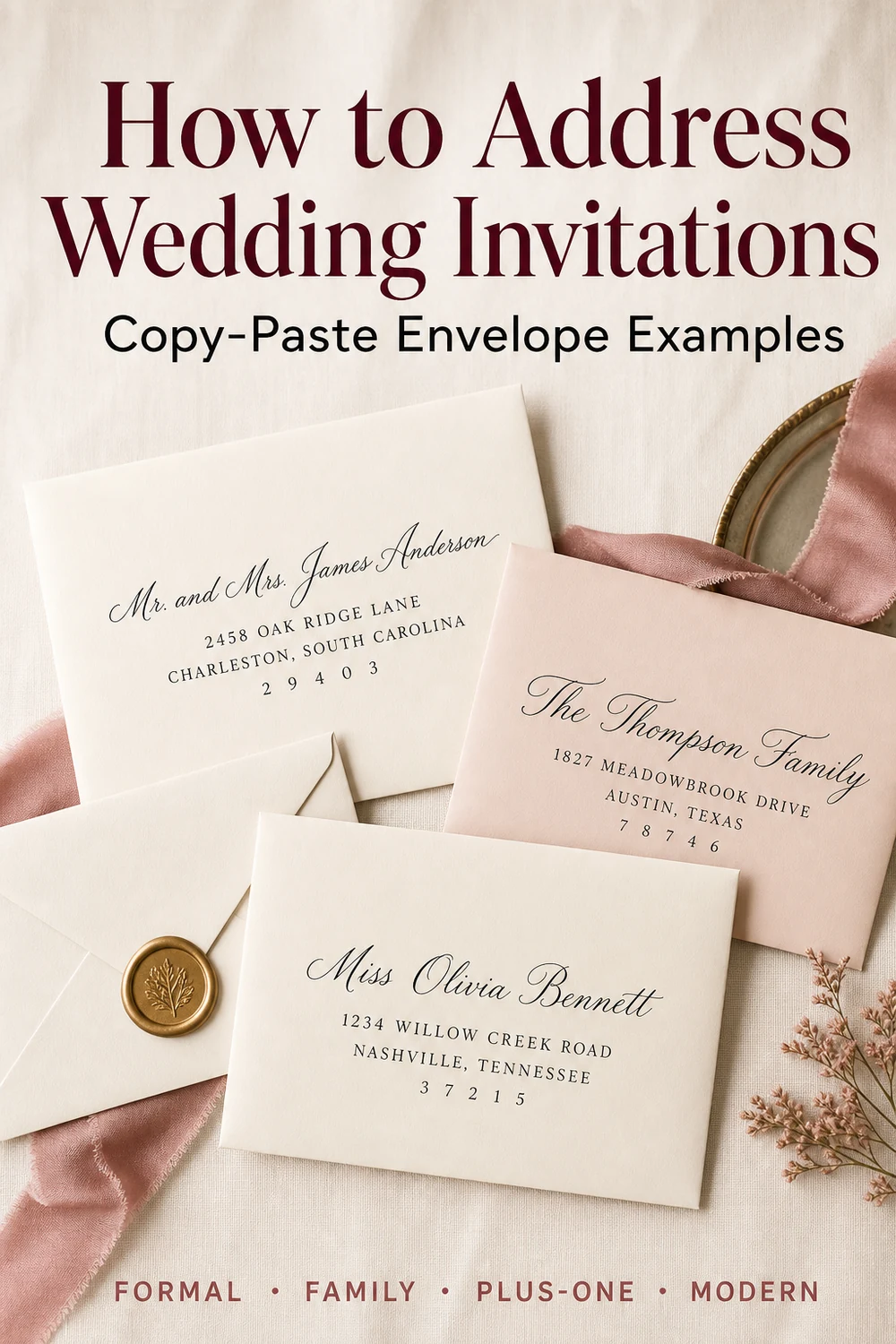
How you address a wedding invitation tells guests exactly who is invited. The names on the envelope are not decoration. They are the guest list in print: they confirm whether a partner is included, whether children may attend, and whether a plus-one is welcome.
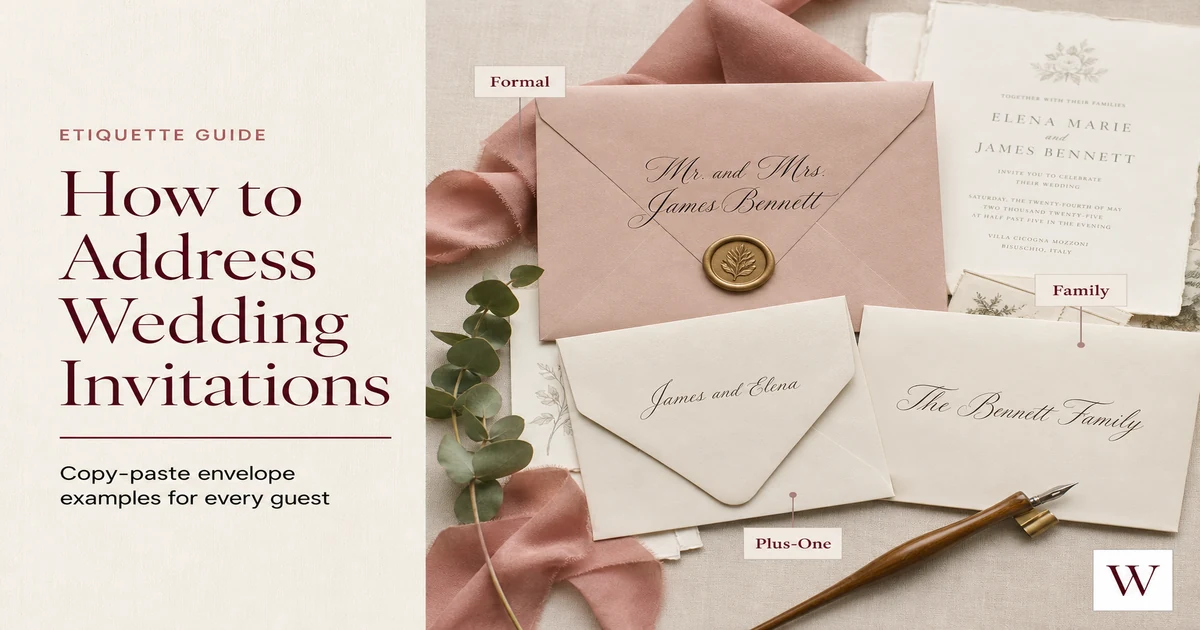
The best wedding envelope addressing is clear, respectful, and consistent with the tone of your invitation. Whether you are using a traditional inner-and-outer envelope suite, a single modern envelope, calligraphy, or printed addressing, this guide explains the etiquette and gives you copy-paste examples for almost every guest situation.
Why Wedding Invitation Addressing Matters
Guests read the envelope before they read the invitation. If the wording is vague, they will guess. That is how extra plus-ones, uninvited children, and awkward RSVP conversations usually begin.
Clear envelope addressing helps you:
- Show who is invited: Name every adult and child who may attend, or make the household limit obvious.
- Set the tone: Formal titles feel classic. First and last names feel modern. Both can be correct.
- Protect your headcount: Your venue, catering, and seating chart all depend on the names you put on the envelope.
- Match your wedding website: The names on the invitation should match the names guests see when they RSVP online.
If you still need wording for the invitation itself, start with Wedding Invitation Wording: What to Write and Copy-Paste Examples for Every Style. For the enclosure card, use Wedding Invitation Details Card Wording.
Outer Envelope vs Inner Envelope
Traditional invitation suites use two envelopes. Many modern suites use only one. Both work if the invited names are unmistakable.
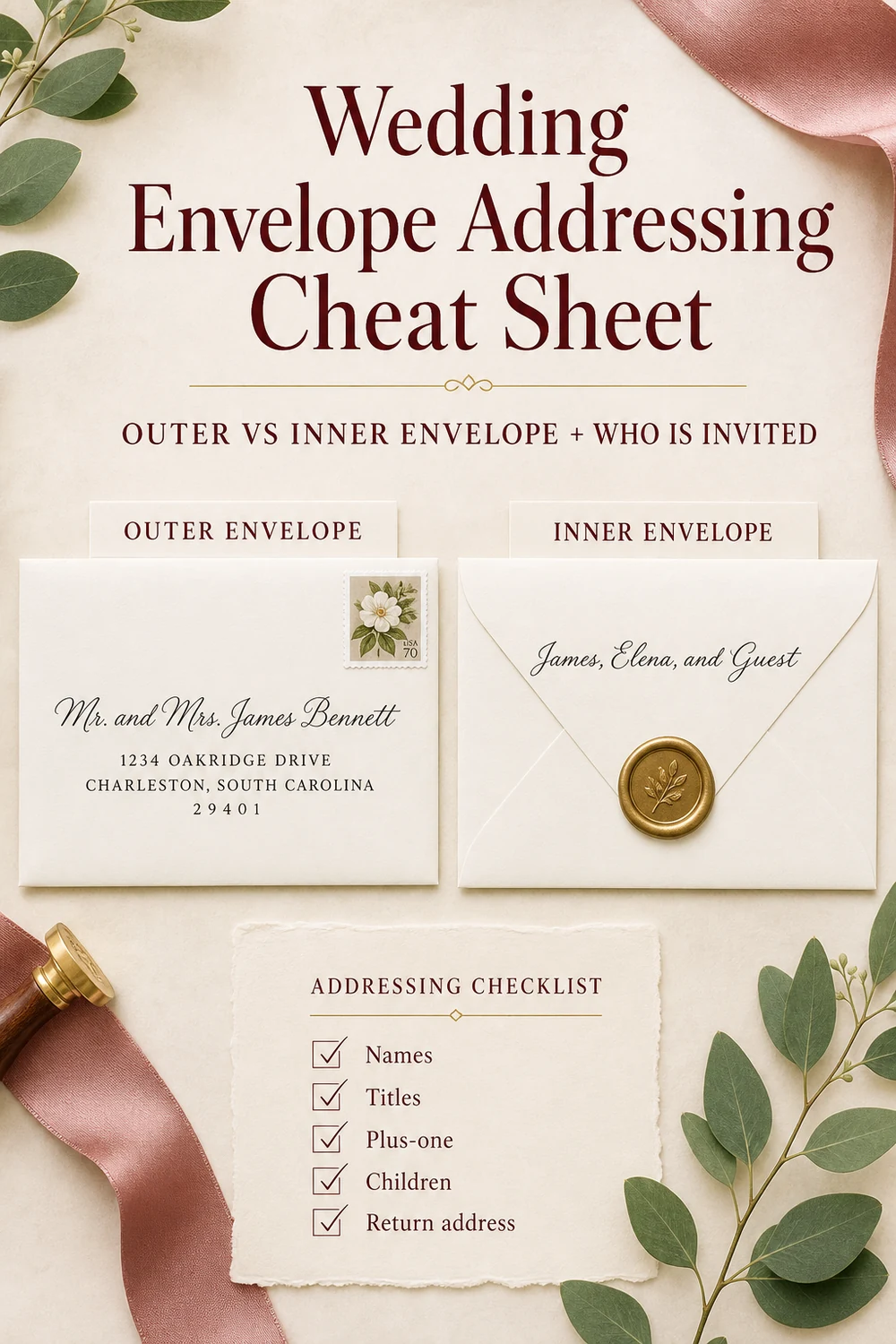
- Outer envelope: This is the mailing envelope. It includes the guest’s full name, titles when you are using them, and the complete postal address. Keep it USPS-friendly: no loose glitter, bulky wax seals that can snag, or writing that covers the barcode area.
- Inner envelope: This stays inside the outer envelope and does not need an address. It names every person invited, including children and named plus-ones. It can be slightly less formal than the outer envelope.
If you are using only one envelope, treat it like the outer envelope and list everyone who is invited. Do not rely on guests to assume that children, partners, or extra guests are included.
Traditional two-envelope example:
Outer envelope
Mr. and Mrs. James Bennett
148 Maple Street
Charleston, South Carolina 29401
Inner envelope
Mr. and Mrs. Bennett
Single-envelope example:
James and Elena Bennett
148 Maple Street
Charleston, South Carolina 29401
What to Include on a Wedding Invitation Envelope
Most envelopes only need a few essential details:
- The invited names: Use the names guests actually use, spelled correctly.
- Titles, if they fit the invitation: Mr., Mrs., Ms., Mx., Dr., or military rank can appear on formal envelopes. Modern envelopes may omit titles.
- The mailing address: Street, apartment or unit, city, state, and ZIP code. Spell out Street, Avenue, and Apartment on formal envelopes.
- A return address: Usually on the back flap. This should be the address that can receive undeliverable mail and RSVP cards if you are using them.
A simple formal envelope can say:
Mr. and Mrs. [Full Name]
[Street Address]
[City, State ZIP]
A simple modern envelope can say:
[First Name] and [First Name] [Last Name]
[Street Address]
[City, State ZIP]
Formal vs Modern Wedding Envelope Addressing
Match the envelope to the invitation, not to a rule from another wedding.
- Formal: Use titles, full names, and spelled-out street words. Avoid nicknames, initials, and “and Guest” on the outer envelope when you can name the person.
- Modern: First and last names are enough. You may skip titles, use numerals, and write a more conversational household line such as “The Bennett Family.”
- Casual: First names can work for a backyard wedding, but add last names when two households could be confused.
Whatever style you choose, use it consistently from save-the-dates through thank you cards. Guests notice when one envelope says “Mr. and Mrs. Bennett” and the RSVP page says “Jim and Ellie.”
How to Address a Married Couple With the Same Last Name
This is the most traditional format. On a formal outer envelope, the historically standard line uses one shared last name. A modern version names both people.
Formal outer envelope
Mr. and Mrs. James Bennett
148 Maple Street
Charleston, South Carolina 29401
Modern outer envelope
James and Elena Bennett
148 Maple Street
Charleston, South Carolina 29401
Inner envelope
Mr. and Mrs. Bennett
or
James and Elena
If Elena prefers not to be folded into her partner’s first name, use both first names on the outer envelope even for a formal wedding. Respect beats tradition when the two conflict.
How to Address a Married Couple With Different Last Names
List both full names. On a formal envelope, put each name on its own line or connect them with “and.” Alphabetical order is a clean default. You can also lead with the person you know better.
Formal outer envelope
Ms. Elena Torres and Mr. James Bennett
148 Maple Street
Charleston, South Carolina 29401
Two-line formal outer envelope
Ms. Elena Torres
Mr. James Bennett
148 Maple Street
Charleston, South Carolina 29401
Modern outer envelope
Elena Torres and James Bennett
148 Maple Street
Charleston, South Carolina 29401
Inner envelope
Ms. Torres and Mr. Bennett
or
Elena and James
How to Address an Unmarried Couple Living Together
Name both people. Do not use “Mr. and Mrs.” if they are not married. List the person you are closer to first, or use alphabetical order.
Formal outer envelope
Ms. Priya Shah and Mr. Daniel Cole
22 Harbor Lane, Apartment 4B
Brooklyn, New York 11201
Modern outer envelope
Priya Shah and Daniel Cole
22 Harbor Lane, Apt 4B
Brooklyn, NY 11201
Inner envelope
Ms. Shah and Mr. Cole
or
Priya and Daniel
How to Address a Single Guest
Use the guest’s preferred name and title. If they are invited with a plus-one, do not print “and Guest” on the outer envelope when you can learn the guest’s name in time. If you cannot, put the plus-one on the inner envelope or on a single envelope after the named guest.
Formal outer envelope
Ms. Lauren Patel
410 Pine Avenue
Austin, Texas 78703
Inner envelope with a plus-one
Ms. Patel and Guest
Modern single envelope with a named plus-one
Lauren Patel and Chris Nguyen
410 Pine Avenue
Austin, Texas 78703
If a guest is not invited with a plus-one, address the envelope to that person only. The absence of a second name is the invitation rule.
How to Address a Wedding Invitation With a Plus-One
A plus-one is an invited guest. Treat the name with the same care as every other name on your list.
- If you know the plus-one’s name: Use it. “Lauren Patel and Chris Nguyen” is clearer and kinder than “Lauren Patel and Guest.”
- If you do not know the name yet: Use “and Guest” on the inner envelope, or on a single envelope after the named invitee.
- If there is no plus-one: Do not add “and family,” “and Guest,” or a blank second line.
Formal two-envelope plus-one
Outer: Ms. Lauren Patel
Inner: Ms. Patel and Guest
Modern single envelope plus-one
Lauren Patel and Guest
410 Pine Avenue
Austin, Texas 78703
Your RSVP form should match the envelope. If the invitation includes a plus-one, the wedding website should allow that second response. If it does not, the form should not offer an extra guest field. For wording that explains invitation limits, see How to Explain Who Is Invited on Your Wedding Website.
How to Address a Family With Children
The outer envelope is usually addressed to the parents or the heads of household. The inner envelope, or the single envelope if you are using only one, should name the children if they are invited.
Outer envelope
Mr. and Mrs. David Chen
88 Willow Road
Portland, Oregon 97209
Inner envelope with children invited
Mr. and Mrs. Chen
Mia and Noah
Modern family envelope when everyone is invited
The Chen Family
David, Hannah, Mia, and Noah
88 Willow Road
Portland, Oregon 97209
If children are not invited, do not write “The Chen Family.” Address the adults only:
Outer envelope for an adults-only wedding
David and Hannah Chen
88 Willow Road
Portland, Oregon 97209
Inner envelope
David and Hannah
Put the adults-only explanation on your details card or wedding website, not in a scolding line on the envelope. Clear names are more polite than “No children.”
How to Address Same-Sex Couples
Use the same structure you would use for any couple: both names, accurate titles, and a respectful name order. Alphabetical order is a useful default. You can also ask which order they prefer.
Married couple, same last name
Mrs. and Mrs. Amelia Carter
or
Amelia and Sofia Carter
Married couple, different last names
Mx. Jordan Hale and Mx. Sam Rivera
or
Jordan Hale and Sam Rivera
Unmarried couple
Alex Morgan and Taylor Brooks
Do not force “Mr. and Mrs.” language onto a couple it does not describe. If you are unsure about titles, first and last names are the most respectful modern choice.
How to Address Divorced or Widowed Guests
Use the name the guest currently uses. Do not assume a divorced or widowed guest kept or dropped a former married name.
Divorced guest who uses a former married name
Mrs. Catherine Walsh
or
Ms. Catherine Walsh
Divorced guest who uses a birth name
Ms. Catherine Brennan
Widowed guest
Mrs. Robert Lang
or, more current and often preferred,
Mrs. Margaret Lang
or
Margaret Lang
When in doubt, ask a family member or check how the guest signs emails. A quick confirmation is better than an envelope that uses a name they no longer use.
How to Address Doctors, Military Guests, Judges, and Clergy
Professional titles belong on formal envelopes when the title is part of how the guest is usually addressed. On modern envelopes, you can still include them if the guest would expect it.
Doctor, one guest
Doctor Maya Singh
or
Dr. Maya Singh
Two doctors, same last name
Doctors Maya and Rohan Singh
One doctor and a partner with a different last name
Doctor Maya Singh and Mr. Rohan Patel
Military rank
Captain Elena Ruiz and Mr. James Ruiz
Judge
The Honorable Daniel Okonkwo and Mrs. Grace Okonkwo
Clergy
The Reverend Hannah Cole and Mr. Oliver Cole
Spell out “Doctor,” “Captain,” and “The Reverend” on the most formal envelopes. Abbreviations are acceptable on modern envelopes if the rest of the suite is also contemporary.
Gender-Neutral and No-Title Addressing
If a guest uses Mx., uses no title, or has asked you not to use gendered honorifics, follow that preference on every envelope and on your wedding website.
With Mx.
Mx. Avery Kim
120 Garden Court
Seattle, Washington 98102
No title
Avery Kim
120 Garden Court
Seattle, Washington 98102
Couple with no titles
Avery Kim and Riley Chen
120 Garden Court
Seattle, Washington 98102
This is also the safest approach when you are not sure which title a guest prefers.
Return Address Wording
The return address usually belongs on the back flap of the outer envelope. Use the names of the people who should receive undeliverable invitations and paper RSVP cards.
Couple hosting
[Name] and [Name]
[Street Address]
[City, State ZIP]
Parents hosting
[Host names]
[Street Address]
[City, State ZIP]
If guests will RSVP on your wedding website instead of a reply card, the return address is still necessary for the postal service. Add the website on the details card, not as a substitute for the back-flap address. For website and RSVP wording, see Wedding Invitation Details Card Wording and How a Wedding RSVP With QR Code Works.
Abbreviations, Punctuation, and Handwriting
- Formal envelopes: Spell out Street, Avenue, Boulevard, Apartment, and the state name. Titles such as Mr., Mrs., Ms., and Dr. may still be abbreviated.
- Modern envelopes: St., Apt., and two-letter state codes are fine when they match a contemporary invitation.
- No end punctuation: Do not put a period at the end of the last address line.
- Ink and contrast: Dark ink on a light envelope is easiest for guests and for postal sorting.
- Hand-canceling: If you use wax seals, ribbon, or thick calligraphy, ask the post office to hand-cancel the envelopes so machines do not scuff the design.
Print a test envelope and mail it to yourself before you address the full set. Confirm that the names, spacing, and postage look the way you expect when they arrive.
How Envelope Addressing Connects to Your Wedding Website
The envelope starts the guest list. Your wedding website should finish it. Every name on an invitation should appear the same way on the RSVP page, seating notes, and any meal-choice form.
- Match the names: If the envelope says “Elena Torres and James Bennett,” do not make them search for “Mr. and Mrs. Bennett.”
- Match the plus-ones: Only guests whose envelopes include a second person should see a plus-one field.
- Match the children: If children are named on the inner envelope, include them in the RSVP household. If they are not named, do not display a kids’ meal question.
- Use one link: Put the wedding website on the details card, RSVP card, or QR code so guests do not have to guess where to reply.
Weddnesday helps you keep that guest list consistent: one website, one RSVP form, and clear household settings so the envelope and the online reply say the same thing.
A Simple Envelope Addressing Formula
When you are unsure, use this structure:
- Line 1: Invited adult names, with titles if you are using them.
- Line 2: Named children or “and Guest,” only if they are invited and you are using a single envelope.
- Line 3: Street address and apartment or unit.
- Line 4: City, state, and ZIP code.
Copy-paste formula:
[Title] [Full name] [and [Title] [Full name]]
[Street Address]
[City, State ZIP]
Inner envelope formula:
[Names of every invited person]
Wedding Invitation Addressing Checklist
- Confirm the spelling of every guest’s current name.
- Confirm titles, pronouns, and whether a guest uses Mx. or no title.
- Decide whether you are using inner envelopes or a single envelope.
- Name every invited adult on the envelope guests will see.
- Name invited children, or omit them if the wedding is adults-only.
- Replace “and Guest” with a real name whenever you can.
- Check apartment numbers, ZIP codes, and international postal codes.
- Add a return address that can receive undeliverable mail.
- Match envelope names to your wedding website RSVP households.
- Order extra envelopes for mistakes and last-minute guests.
- Mail a test envelope to yourself.
- Ask one other person to proofread the full list before you send.
Common Wedding Envelope Addressing Mistakes
- Writing “and family” when children are not invited: Guests will assume the whole household is included.
- Leaving a partner off the envelope: If someone is invited, their name should appear.
- Using a nickname the guest does not use: Formal invitations should use the name they would put on a reply.
- Mixing styles: Do not use “Mr. and Mrs.” on half the list and first names on the rest unless you have a reason.
- Printing an unconfirmed plus-one: Decide the guest list before you print.
- Forgetting the inner envelope names: If children or a plus-one are only implied, guests may guess incorrectly.
- Ignoring your RSVP page: An envelope that says one thing and a website that says another creates extra questions.
Build One Guest List and Use It Everywhere
Addressing goes faster when the guest list is already clean. Keep one household list with envelope names, mailing addresses, plus-one permissions, and child names. Use that same list for save-the-dates, invitations, RSVPs, seating, and thank you cards.
Weddnesday helps couples turn that list into a guest-friendly wedding website with online RSVPs, so the names on the envelope match the names guests see when they reply. You can also use the Wedding Invitation Wording Guide when the cards themselves are ready, and the Wedding Thank You Card Wording Guide after gifts arrive.
FAQ
How do you address a wedding invitation?
Write the invited guests’ names on the outer envelope with their mailing address. If you use an inner envelope, list every person invited, including children and named plus-ones. Use titles for a formal suite, or first and last names for a modern suite.
Do you need inner and outer envelopes?
No. Two envelopes are traditional, but one envelope is common and perfectly correct. If you use only one envelope, name every invited person on it.
Whose name goes first on a wedding envelope?
For different last names, alphabetical order is a clean default. You may also list the person you know better first. For a married couple sharing a last name, a traditional envelope may use “Mr. and Mrs. [Husband’s full name],” while a modern envelope names both people.
How do you address a wedding invitation to a family?
Address the outer envelope to the parents or heads of household. Name the children on the inner envelope, or on the single envelope if they are invited. If children are not invited, list the adults only and do not write “and family.”
How do you address a wedding invitation with a plus-one?
Use the plus-one’s name whenever you know it. If you do not, add “and Guest” on the inner envelope or after the named guest on a single envelope. Do not add “and Guest” if that person is not invited.
Should you use Mr. and Mrs. on wedding invitations?
Only if it matches the couple and the formality of the wedding. Many couples now prefer both first names, different last names listed separately, or no titles at all.
Where does the return address go?
On the back flap of the outer envelope. Use the names and address of the person who should receive undeliverable mail and any paper RSVP cards.
Can you print wedding envelope addresses instead of handwriting them?
Yes. Printed addressing is widely accepted, especially for large guest lists. Choose a clear, elegant font that matches the invitation and keep the names easy to read.
Should envelope names match the wedding website RSVP?
Yes. Guests should find themselves under the same names they saw on the envelope. Matching households prevents extra plus-ones and missing children’s meals.
What if you spell a guest’s name wrong?
Send a corrected invitation if you still have time. If the original already arrived, a short personal note or message with the correct name is better than hoping they will not notice.
Save These Guides for Later
Wedding Invitation Wording Examples
Wedding Invitation Details Card Wording
Wedding Save-the-Date Wording Examples
How to Explain Who Is Invited on Your Wedding Website
Wedding Thank You Card Wording Examples
Stay Connected
Follow Weddnesday for practical wedding planning advice, guest-friendly wording, invitation ideas, and wedding website inspiration.
Save This on Pinterest