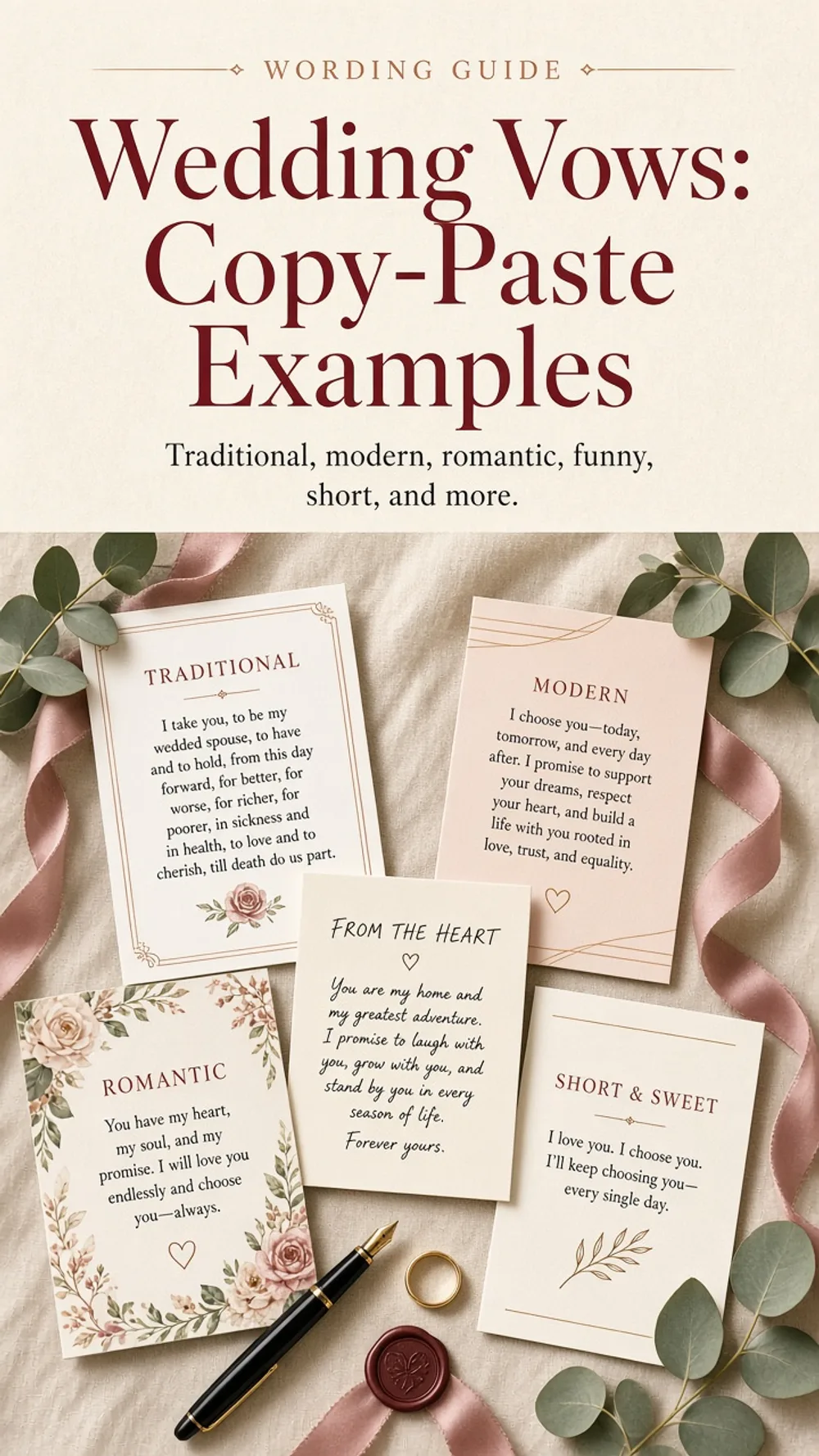
Wedding Vows: How to Write Them and Copy-Paste Examples for Every Style
Writing wedding vows can feel more intimidating than choosing a venue. You want the words to sound like you, hold up in front of the people you love, and still be short enough to say without losing your place. The good news is that strong vows are not a speech, a biography, or a perfect poem. They are a clear promise, spoken in your own voice.
This guide explains how to write wedding vows, what to include, what to leave out, and how long they should be. It also gives you copy-paste examples for traditional, modern, casual, romantic, funny, short, religious, secular, bilingual, destination, elopement, private, and vow renewal ceremonies.
What Are Wedding Vows?
Wedding vows are the promises you make to each other during the ceremony. In a traditional service, you may repeat words led by an officiant. In a more personal ceremony, you may write your own vows, combine a classic phrase with a few original lines, or share longer private vows before a shorter public promise.
Guests do not need a complete history of your relationship. They need to hear that you choose each other, understand what you are promising, and mean it. If you want guests to follow the ceremony more easily, you can also add a short ceremony outline to your wedding website. The Wedding Website Schedule Wording guide is a useful place to start.
Should You Write Your Own Vows or Use Traditional Vows?
Both options are correct. Choose the format that matches the ceremony, your comfort in front of a crowd, and the tone you want the moment to have.
- Traditional vows work well for religious ceremonies, formal venues, and couples who want language that already feels complete.
- Written vows work well when you want specific memories, humor, or promises that only the two of you would make.
- A hybrid is often the easiest: keep a traditional “I take you” line, then add one or two personal sentences before or after it.
Agree on the format together before either of you starts drafting. One person should not surprise the other with a five-minute story if the other person planned to say four classic lines.
What to Include in Wedding Vows
Most memorable vows include a few of the same pieces, even when the wording is completely different:
- A direct address: Say your partner’s name early so the promise feels personal.
- One specific reason you choose them: A quality, habit, or moment that is recognizably yours.
- A short look at your life together: How you met, what you have already built, or what you admire.
- Clear promises: The heart of the vows. Say what you will do, not only how you feel today.
- A future line: One sentence about the life you want to keep choosing.
- A closing: A simple “I do,” “This is my vow,” or “I choose you.”
A simple vow can follow this structure:
[Name], I love you.
I choose you for [specific reason].
I promise to [promise 1], [promise 2], and [promise 3].
I will keep choosing you in [ordinary and difficult moments].
Today, and every day after this, I am yours.
What Not to Put in Wedding Vows
Vows become weaker when they try to do too many jobs. Leave these out of the ceremony version, even if they are true:
- Inside jokes nobody else can follow: A small smile is welcome. A story that needs a five-minute explanation is not.
- Exes, almost-breakups, or family tension: The ceremony is not the place to process old conflict.
- A full relationship timeline: Save the long version for a speech, a letter, or your wedding website story page.
- Promises you cannot keep: “I will never be late” is riskier than “I will come back to you when I get it wrong.”
- Notes that embarrass your partner: If it would make them freeze, cut it.
- A toast to the guests: Thank-yous belong in speeches, programs, or a welcome message, not in the vows themselves.
If you have more to say than the ceremony can hold, write private vows for each other and keep the public version shorter. For a guest-facing welcome that does not compete with the ceremony, see Wedding Website Welcome Message Examples.
How Long Should Wedding Vows Be?
Most ceremony vows work best at about one to two minutes spoken aloud. That is usually 150 to 250 words. Three minutes can still feel right if both partners agree on that length. Much longer, and guests start watching the speaker instead of listening to the promise.
Read the draft out loud. If you run out of breath, lose the thread, or feel as if you are giving a speech, shorten it. A useful target is three to five promises, not twelve.
Match each other within about 30 to 50 words. One 45-second vow next to one four-minute vow can make the shorter one sound unfinished, even when it is not.
When Should You Write Your Vows?
Start two to six weeks before the wedding. That is enough time to draft, cut, and practice without turning the vows into another last-minute task.
- Four to six weeks before: Decide whether you will write your own, use traditional wording, or combine the two. Ask the officiant if there are required lines.
- Two to three weeks before: Write a first draft. Put it away for a day, then cut anything that sounds generic or too long.
- One week before: Practice out loud. Print a clean copy, and give a backup to the officiant.
- The day before: Read them once. Do not keep rewriting while you are already tired.
If you are exchanging vows privately before the ceremony, finish those earlier so the public version can stay short and steady.
A Simple Formula for Writing Wedding Vows
If the blank page is the problem, fill in this formula first and only then polish the sentences:
- Opening: “[Name], today I marry you.”
- Why them: One specific quality or memory.
- What you have already learned: One sentence about your life together so far.
- Promises: Three commitments you can keep.
- Ordinary-life line: One promise for weekdays, not only wedding days.
- Closing: “I choose you. This is my vow.”
Copy-paste formula:
[Name], I take you as my [spouse / husband / wife / partner].
I love [specific quality].
I promise to [promise 1], to [promise 2], and to [promise 3].
I will stand with you in [joy] and in [difficulty].
I choose you today, and I will keep choosing you.
This is my solemn vow.
Traditional Wedding Vows
Traditional vows are familiar, formal, and complete. They work well when you want the ceremony to sound classic, when family expects a religious service, or when you would rather not write a long original text.
Classic Christian-style vows:
I, [Name], take you, [Name], to be my wife / husband,
to have and to hold from this day forward,
for better, for worse,
for richer, for poorer,
in sickness and in health,
to love and to cherish,
until we are parted by death.
This is my solemn vow.
Officiant-led version:
[Name], will you have [Name] to be your wife / husband?
Will you love her / him, comfort her / him, honor and keep her / him,
in sickness and in health, and, forsaking all others,
be faithful to her / him as long as you both shall live?
I will.
Ring-exchange line:
[Name], I give you this ring as a sign of my vow,
and with all that I am, and all that I have, I honor you.
Use “honour” if the rest of the ceremony uses British spelling. Use “honor” if the invitation and program use American spelling. Keep the same choice everywhere guests will read it, including the ceremony notes on your wedding website.
Modern Wedding Vows
Modern vows keep the promise clear while sounding like the way you actually speak.
[Name], I choose you.
I love your mind, your humor, and the way you make ordinary days feel like home.
I promise to listen when it would be easier to defend myself,
to tell you the truth even when it is uncomfortable,
and to keep building a life that has room for both of us.
I will celebrate your wins, sit with you in hard seasons, and keep reaching for your hand.
Today I marry you, on purpose.
[Name], you are my favorite person and my safest place.
I promise to keep choosing curiosity over pride,
partnership over scorekeeping,
and us over the version of life that would be easier alone.
I will love you loudly on the good days and steadily on the quiet ones.
This is my vow.
I take you, [Name], as my person.
I promise to keep making a home with you,
to keep learning you,
and to keep showing up when it matters.
I am yours, and I am proud to say that in front of the people who love us.
Casual Wedding Vows
Casual vows suit backyard weddings, courthouse ceremonies, restaurant receptions, and couples who would rather sound like themselves than like a printed program.
[Name], I love you. That is the headline.
I promise to keep making you coffee, keep laughing with you, and keep picking us when the week gets messy.
I will be on your team. I will tell you when I am wrong. I will save you the good seat.
I am so glad it is you.
I did not know I could feel this sure.
[Name], I promise to keep being someone you can relax around.
I will celebrate the small stuff, handle the hard stuff, and come home to you.
Let’s do this.
[Name], you are my person.
I vow to keep choosing you, keep making room for your dreams, and keep filling our life with good meals, honest talks, and a lot of ordinary happiness.
I do.
Romantic Wedding Vows
Romantic vows can be warm without becoming a poem that is difficult to say out loud.
[Name], I loved you before I had the words for it,
and I love you more now that I know the details:
your voice in the morning, your patience, the way you look at me when you are proud.
I promise to protect this love, to keep growing it, and to never treat it as finished.
You are my home, my joy, and my forever yes.
With you, my life feels both calmer and more alive.
I promise to keep falling in love with the person you are becoming,
to hold you gently, and to choose you again in every season we are given.
[Name], I am yours.
I take your hand today because it already feels like the rest of my life.
I promise to love you with tenderness, loyalty, and attention.
I will keep writing this story with you, one ordinary day at a time.
Funny and Playful Wedding Vows
Humor works when it is kind, brief, and followed by a real promise. One joke is usually enough.
[Name], I promise to love you even when you steal the blankets,
to support your snack-based decision making,
and to laugh with you before I try to solve anything.
More importantly, I promise to be your partner in the unfunny parts too:
the bills, the hard news, the days that ask more of us than we planned.
I choose you, punchlines and all.
I knew I was in trouble when I started saving stories all day just to tell you at night.
I promise to keep being your favorite audience, your backup plan, and your biggest fan.
I will love you on the days we are brilliant and the days we are a little ridiculous.
That is the deal, and I am in.
[Name], I vow to share the last bite, admit when I am lost, and never let a silent car ride last longer than it should.
I also vow to take this seriously: you have my loyalty, my patience, and my whole heart.
I do.
Short Wedding Vows
Short vows are often the most powerful, especially outdoors, in wind, or when either of you expects to be emotional.
[Name], I love you. I choose you. I promise to stand with you, tell you the truth, and keep building a kind life together. This is my vow.
I take you, [Name], to be my partner in all things.
I will love you, respect you, and come home to you.
Today and always.
[Name], you have my heart, my loyalty, and my yes.
I marry you now, and I will keep marrying you in the life we make after today.
I choose you, [Name], for the rest of my days.
I promise to love you well.
Religious and Spiritual Wedding Vows
If you are including faith language, ask the officiant which lines are required and which can be personalized. Keep the sacred words intact, then add a short personal sentence if that is welcome.
Christian personal addition:
[Name], I thank God for you.
I promise to love you as a partner, a friend, and a faithful companion.
I will pray for you, stand with you, and seek grace when we fall short.
With God’s help, I take you as my wife / husband from this day forward.
Jewish-inspired personal line after traditional blessings:
[Name], I enter into this covenant with joy.
I promise to honor you, to make our home a place of peace, and to walk with you in love all the days of our life.
Spiritual, non-denominational:
[Name], before these witnesses and with a grateful heart,
I promise to love you with humility, to keep our life honest, and to treat this marriage as sacred.
May we be gentle with each other, brave for each other, and faithful to the life we are beginning today.
Secular and Non-Religious Wedding Vows
Secular vows can still feel ceremonial. They simply root the promise in your values rather than in religious language.
[Name], I marry you of my own free choosing.
I promise companionship, honesty, and care.
I will respect your independence, share the work of our life, and keep being someone you can trust.
There is no one else I would rather grow older with.
I do not take this lightly.
I promise to keep loving you in the specific ways you need, not only in the ways that come easily to me.
I will be your partner in plans, in rest, and in every version of the future we make.
[Name], I am so proud to marry you.
Inclusive and Same-Sex Wedding Vows
Use the words that fit your relationship: spouse, partner, wife, husband, or no title at all. The structure stays the same.
[Name], I take you as my spouse and my equal.
I promise to honor the life we have already built and the one we are still creating.
I will protect our home, tell you the truth, and keep choosing a love that makes room for both of us to be fully ourselves.
I am proud to marry you today.
I, [Name], take you, [Name], to be my wife / husband / spouse,
to have and to hold from this day forward,
in joy and in difficulty, in ordinary days and extraordinary ones,
to love and to cherish for all the days of our life.
This is my vow.
Destination Wedding Vows
Destination vows can mention the place, but the place should not replace the promise. One line about the setting is enough.
[Name], we traveled here to say something simple:
I choose you.
I promise to be your home wherever we go next,
to keep adventure from turning into restlessness,
and to keep us close when the world feels wide.
Thank you for being the person I want beside me, here and everywhere after this.
In this place, in front of the people who made the journey,
I take you, [Name], as my partner.
I promise love, patience, and a shared sense of direction.
Wherever we land, I am yours.
If guests have traveled for the wedding, put travel, timing, and ceremony notes on your website rather than inside the vows. Use Destination Wedding Website Must-Haves so those details stay easy to find.
Elopement and Intimate Ceremony Vows
Small ceremonies can hold slightly more personal language because you are not performing for a large room. Still keep a clear promise at the center.
[Name], it is just us, and that is exactly right.
I promise a marriage that feels like this moment: honest, close, and chosen with a full heart.
I will keep making a life with you that does not need an audience to be real.
I marry you today with no extra noise.
I promise to love you, to keep you as my person, and to tell you the truth in a quiet room and a crowded one.
This is enough. You are enough. We are enough.
Private Vows and Letter Vows
Private vows are useful when you want to say more than the ceremony can hold, or when one of you does not want to cry through a long public reading. Exchange them the morning of the wedding, the night before, or in a first look.
Private vow letter opening:
[Name],
I wanted you to have these words without a microphone.
Thank you for the life we already share. Thank you for the way you love me when I am easy and when I am not.
Today I promise you a marriage with attention, humor, and loyalty.
I cannot wait to keep choosing you.
Yours,
If you write private vows, keep the public version to a few lines so guests still witness a complete promise. Do not let the private letter replace the ceremony entirely unless that is the plan you have both agreed to.
Bilingual Wedding Vows
Bilingual vows help both families feel included. Keep each language short enough that the moment does not become a translation exercise.
English / Spanish:
[Name], I take you as my wife / husband.
I promise to love you, honor you, and walk with you all the days of my life.
[Name], te elijo hoy.
Prometo amarte, respetarte y construir contigo un hogar lleno de cuidado.
This is my vow. Esta es mi promesa.
English / French:
[Name], I choose you.
I promise love, loyalty, and a shared home.
[Name], je te choisis.
Je promets de t’aimer, de te soutenir, et de faire route avec toi.
Today I marry you.
Print both versions in the ceremony program if guests will not understand one of the languages. A short note on your wedding website can also explain that vows will be shared in both languages.
Vow Renewal Wording
A vow renewal can echo the original ceremony or sound like the life you have lived since then. Mention time, but do not turn the vows into a résumé.
[Name], I chose you then, and I choose you still.
I know more now: your strength, your tell when you are tired, the way you keep showing up.
I promise again to love you, to keep growing with you, and to honor the years behind us and the years ahead.
I marry you again today.
With more history and even more certainty,
I take you, [Name], to be my spouse.
Thank you for the life we have made.
I promise the next chapter with the same yes I gave you the first time.
Matching Partner Vows Without Sounding Identical
You do not need the same sentences. You do need a similar length, a similar level of humor, and a similar level of privacy. Decide these points together:
- Approximately how long each person will speak.
- Whether jokes are welcome.
- Whether you will hear the vows before the ceremony.
- Whether you will read, memorize, or repeat after the officiant.
- Whether a traditional line should appear in both vows so they feel connected.
A simple shared closer can tie different drafts together:
I choose you, [Name]. This is my vow.
or
I do. I will. I promise.
Should You Share Your Vows Before the Wedding?
There is no required etiquette here. Sharing drafts can prevent a mismatch in tone or length. Keeping them secret can make the ceremony feel more immediate. A practical middle ground is to share the first and last lines, or to let the officiant read both for length without quoting them back to you.
If either of you is easily overwhelmed, do not aim for a dramatic surprise. The guests will remember a steady, heartfelt promise more than a reveal.
How to Read Wedding Vows Without Falling Apart
Most people get emotional. Plan for that instead of hoping you will not.
- Print the vows in a large, clear font on a card or in a small booklet. Do not rely on your phone unless that is a deliberate, well-tested choice.
- Mark pauses after the lines most likely to catch in your throat.
- Look up between sentences, not in the middle of a long clause.
- Give a copy to the officiant so someone can help if the card is lost or the wind takes it.
- Practice standing up, not only in your head. Time yourself.
- If you cry, pause. The room will wait. Starting the next sentence is enough.
If you are having an unplugged ceremony, tell guests on the wedding website and in the program so phones are not lifted during the vows. The Unplugged Ceremony Wording guide includes copy you can use.
Where Wedding Vows Belong on Your Wedding Website
The vows themselves are usually private. The ceremony information around them is not. Guests still need to know when to arrive, whether phones should stay away, and what happens immediately after you are married.
Useful website notes include:
- Ceremony start time and how early guests should be seated.
- Whether the ceremony is unplugged.
- Whether there will be a program, reading, or cultural ritual to explain.
- What guests should do after the recessional.
You do not need to publish the vow text. If you want a keepsake later, save the wording in a private place and share photos when you are ready. For guest photo requests, use Wedding Website Photo Sharing Wording.
Wedding Vow Mistakes to Avoid
- Writing them the night before: Tired edits rarely sound like you.
- Copying a template word for word: Use examples as a scaffold, then replace every generic line with something true.
- Making it a roast: Playful is good. Mean is not.
- Listing too many promises: Three strong ones land better than ten vague ones.
- Ignoring the officiant’s required language: Some ceremonies must include specific legal or religious lines.
- Memorizing a long text you have not practiced: Read if that helps you stay present.
- Forgetting a backup copy: Print two.
Wedding Vows Checklist Before the Ceremony
- Agree on traditional, personal, or hybrid vows.
- Confirm any required wording with the officiant or registrar.
- Decide whether the vows will be shared before the wedding day.
- Write a draft using the formula, then cut it until it is one to two minutes.
- Match length and tone with your partner.
- Replace generic phrases with one or two specific details.
- Remove jokes or stories that need extra context.
- Read the final version out loud at least three times.
- Print a clean copy and a backup.
- Give the officiant the backup, especially for outdoor ceremonies.
- Tell guests on the wedding website if the ceremony is unplugged.
- Stop rewriting the day before the wedding.
Say the Vows, Then Point Guests to One Clear Place
Your vows are for the two of you. Everything around them—ceremony time, seating, unplugged requests, travel, and what happens after you walk back down the aisle—belongs where guests can find it without asking you.
Weddnesday helps couples create a guest-friendly wedding website with the schedule, RSVP, travel details, and ceremony notes in one link. Write the vows in your own words, then put the practical information online so the ceremony can stay personal.
FAQ
How do you write wedding vows?
Start with your partner’s name, one specific reason you choose them, three promises you can keep, and a short closing. Read the draft out loud and cut anything that sounds like a speech, a roast, or a timeline of your relationship.
How long should wedding vows be?
One to two minutes is a strong target, usually 150 to 250 words. Agree on length with your partner so one vow is not much longer than the other.
When should you write your wedding vows?
Begin two to six weeks before the wedding. Finish a week out so you have time to practice and print a clean copy.
Do you have to write your own vows?
No. Traditional vows are a complete and meaningful choice. Many couples use classic wording, write their own, or combine a traditional promise with a few personal lines.
What should you not say in wedding vows?
Avoid exes, unresolved family issues, jokes that embarrass your partner, and promises you cannot keep. Save long stories and guest thank-yous for speeches or your wedding website.
Should we see each other’s vows before the ceremony?
Only if that makes you more comfortable. Sharing can prevent a mismatch in tone or length. Keeping them private can make the moment feel more immediate. Let the officiant check both for timing if you want a middle option.
Can wedding vows be funny?
Yes, if the humor is kind and brief. Follow the joke with a real promise so the vows still sound like a marriage, not a toast.
Can we say different vows?
Yes. They do not need to match word for word. They should be similar in length, tone, and how personal they get.
Should we memorize our vows?
Only if you can do it without stress. Reading from a card is completely acceptable and often better, especially if you expect to be emotional.
Can we exchange private vows and still have a ceremony?
Yes. Many couples share longer letters privately, then say a shorter public vow during the ceremony so guests still witness the promise.
Do wedding vows need religious language?
Only if that matches your ceremony and beliefs. Secular vows can be just as formal when they include a clear promise, a chosen partner, and a closing.
Where should guests learn about the ceremony if the vows are private?
On your wedding website and, if you use one, the ceremony program. Share timing, seating, unplugged requests, and what happens after the ceremony. You do not need to publish the vow text.
Save These Guides for Later
Wedding Website Schedule Wording
Wedding Invitation Wording Examples
Wedding Website Welcome Message Examples
Wedding Website Photo Sharing Wording
Destination Wedding Website Must-Haves
Stay Connected
Follow Weddnesday for practical wedding planning advice, guest-friendly wording, invitation ideas, and wedding website inspiration.
Save This on Pinterest